
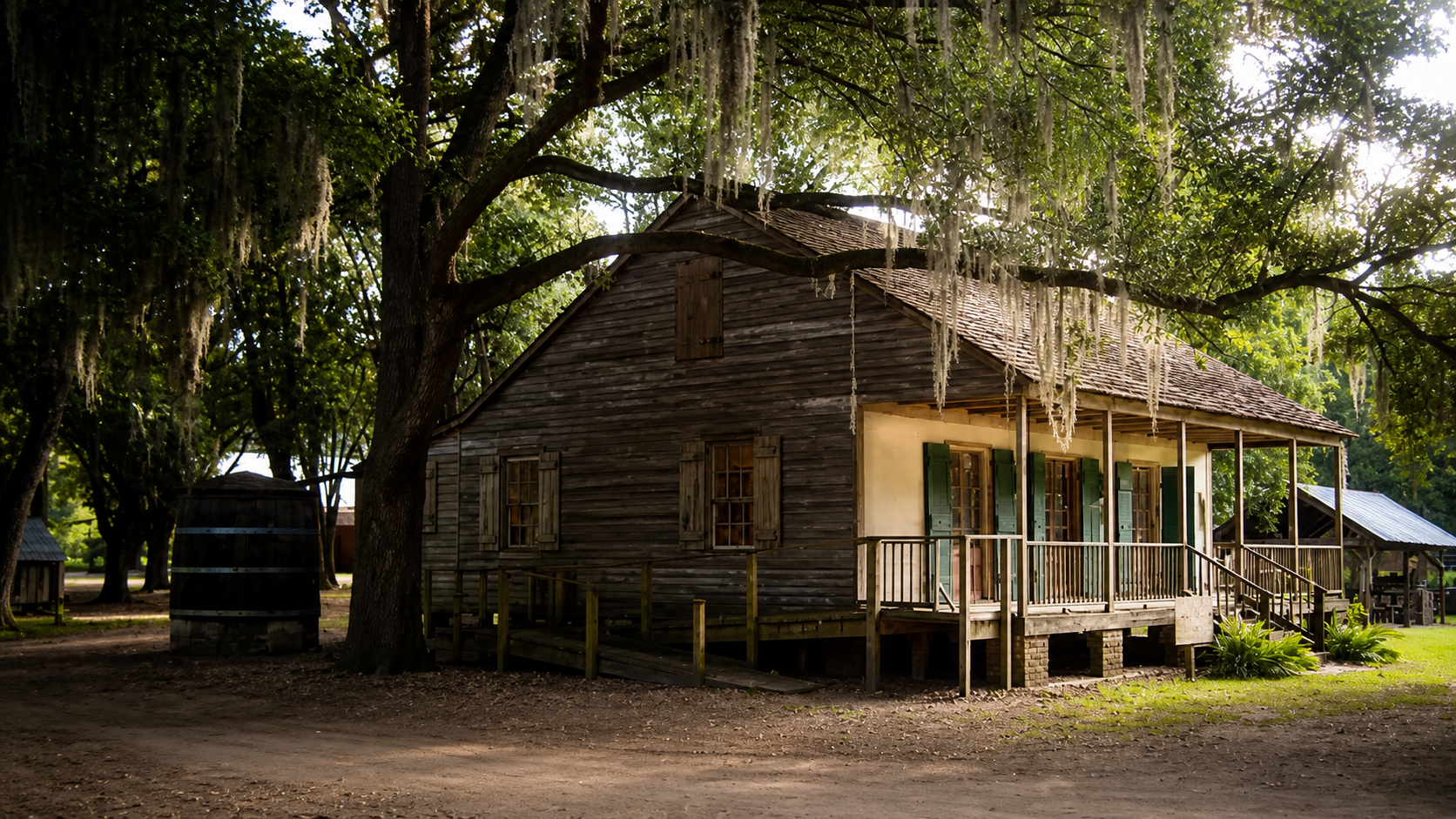
"You'll be introduced by name, not just to the people whose portraits hang in this historic home, but to the enslaved men and women who built this plantation and made it thrive." — from the introduction every guided tour opens with
223 years, in brief
The house is built
Landowner Robin de Logny commissions the house in 1787; Charles Paquet, an enslaved master builder, designs and constructs it by 1790. De Logny paid Paquet in rice, corn, livestock, and cash — and Paquet gained his freedom during the build. Jean Noel Destrehan, who needed roughly 100 enslaved workers to run the sugar fields, becomes the plantation's namesake owner in the years that follow.
The German Coast Uprising
The largest slave revolt in U.S. history, led by Charles Deslondes, moves downriver toward New Orleans before being put down. Jean Noel Destrehan presided over one of the three resulting trials, held at Destrehan, where 67 enslaved people were tried. The Miller-Haydel Museum's exhibit — with artwork by folk artist Lorraine Gendron — tells this history in detail.
The estate divides, then reunites
Jean Noel Destrehan dies in 1823, splitting the estate among his children. In 1839, Pierre Rost — married to Destrehan's daughter Louise Odile — buys the plantation outright, remodels it in the Greek Revival style, and grows it into the largest sugar producer in St. Charles Parish.
Rost Home Colony
Union forces seized the plantation in 1862; formerly enslaved people and refugees live and work there under the Freedmen's Bureau — one of the earliest such colonies in the South — until it's returned to the Rost family in 1867.
Sold, drilled, and abandoned
Emile Rost sells the plantation out of the family in 1910; by 1914 it belongs to the Mexican Oil Company (later Amoco), which builds a refinery and company town on the grounds. When the refinery closes in 1958, the house is abandoned and left to vandals drawn by a local legend of Jean Lafitte's buried treasure.
River Road Historical Society
Local citizens form the Society in 1968; it's chartered by the State of Louisiana in January 1969. Amoco donates the house and roughly four acres to the Society in December 1971, and restoration begins.
A living history museum
Guided tours, exhibits, and education programs keep the full history of the site, family and enslaved community both, in view.
GO DEEPER
The fuller story, organized by chapter.
The timeline gives the overview. These short, expandable chapters preserve the additional historical context from the museum's existing history materials without sending visitors away from the site.
Foundations, family, and early Louisiana
Robin de Logny commissioned Charles Paquet to build the French Colonial home in 1787. The original agreement called for a raised 60-by-35-foot house with a 12-foot gallery and 10-foot brick piers; the double-pitched roof, fireplaces, and locally sourced materials were suited to the Louisiana climate. Completed in 1790, the house still reflects Paquet's workmanship in its cooling room and interpretive spaces. The original contract is preserved at the St. Charles Parish Courthouse.
The Louisiana Destrehan family begins with Jean Baptiste Honore Destrehan, Sieur De Peaupre, who arrived in the colony in 1730 and later served as its treasurer. Jean Noel Destrehan became an important early Louisiana political figure: during the 1803 transfer from Spain to France and then the United States, he advocated for statehood, served as Speaker of the territorial House, helped shape Louisiana's legal framework, later served in the State Legislature, and was elected to the U.S. Senate in 1812.
The 1811 German Coast Uprising
In 1804, the Haitian Revolution reshaped the Atlantic world as enslaved people in Saint-Domingue overthrew French colonial rule and declared independence. On January 8, 1811, Charles Deslondes led an uprising that began at Manuel Andry's plantation in St. John the Baptist Parish. The group moved downriver toward New Orleans, recruiting others along the way.
By January 9, nearby residents had sought refuge at Destrehan. The uprising was violently suppressed over the following days. Three trials followed, with 67 enslaved people tried; Jean Noel Destrehan presided over one proceeding at Destrehan Plantation. The Miller-Haydel Museum interprets this history, including artwork by local folk artist Lorraine Gendron. For the regional trail and free audio program, visit the 1811 German Coast Uprising trail.
Inheritance, Greek Revival remodeling, and the Rost family
After Jean Noel Destrehan died in 1823, the estate passed among his children Nicolas, René, Eleonore Zelia, Louise Odile, and Celeste. Stephen Henderson managed the plantation for a period; after his death, Pierre Rost—married to Louise Odile—purchased it in 1839.
Pierre and Louise remodeled the house in the Greek Revival style beginning in 1840. Rost, a Louisiana Supreme Court justice, modernized the operation; Destrehan became the largest sugar producer in St. Charles Parish and also served as a summer home for the extended family. The Civil War ended this period of profitable sugar production and brought the property into a new chapter.
Home Colony, oil, abandonment, and preservation
Union forces seized the plantation in 1862 and repurposed it as a Home Colony, providing shelter, education, employment, farming, and trade training for formerly enslaved people and white refugees. The federal government returned the property to the Rost family in 1867. Emile Rost later sold the plantation in 1910 to the Destrehan Manufacturing Company.
In 1914, the Mexican Oil Company—later Amoco—acquired the property, built a refinery and company town, and changed the landscape around the house. After the refinery closed in 1958, the house stood abandoned and was damaged by vandals. Local citizens organized in 1968; the River Road Historical Society received its state charter in 1969 and accepted the house and approximately four acres from Amoco in 1971, beginning the preservation work that continues today.
The Enslaved Registry
Primary-source documentation the museum makes available to researchers and visitors, carried over directly from the current site's archive.
1782 Sale Record
Enslaved people included in the 1782 sale of the plantation by Guillaume Guignan to Robert de Logny.
1792 Inventory
Inventory of enslaved people in the estate of Antoine Robert de Logny.
1825 Purchase Record
Enslaved people purchased by Stephen Henderson from the estate of Celeste Robin de Logny, widow of Jean Destrehan.
1838 Succession
Enslaved people included in the succession of Stephen Henderson.
1840–1860 U.S. Census data is also on file, documenting roughly 210 enslaved people at Destrehan by 1850. For archival research inquiries, contact the museum directly at info@destrehanplantation.org.
Since 1968, the River Road Historical Society has preserved the historic buildings of River Road and used Destrehan Plantation as a learning environment — funding new exhibits, education programs, and public events through tour proceeds and donations.
See it in person
A guided tour covers the main house, the enslaved cabin, and both museum exhibits — with a daily historical demonstration on the grounds.